skip to main |
skip to sidebar
 WALKING
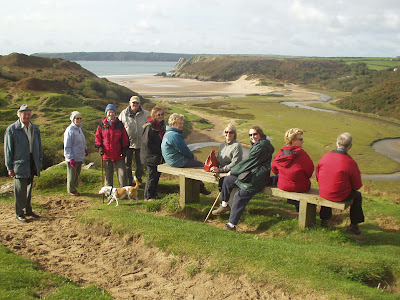
Thanks to Lyn Holt for these two photographs of the walking group at our most famous beauty spot. The most popular question of summer visitors to the National Trust car park at Pennard is 'Am I in the right place for Three Cliffs?' to which the answer is 'not quite' this path leads to Pobbles the adjacent bay. But these walkers obviously know their onions!

GROUP NEWSWe have lift off less than a month after Open Day. Three, or arguably four, new groups are starting this week, and with luck we will finally pull together another reading group next week, with twenty interested that shouldn't prove impossible given a little good will.
FRENCH CONVERSATION
The first of what is expected to be a weekly meeting will be held in the Craft and Hobbies room of Hazel Court, Sketty Parklands, at 10am Thursday 6 November. Twenty one people have said they will come. There are two major advantages to that particular room, the first being that it divides into two equal halves with a sound proof partition, the second is the facility for computers which opens up the possibility of computer or Internet based courses perhaps in conjunction with more conventional conversation exercises.
LEARN MODERN JIVE
The first of what are expected to be weekly sessions will start on Wednesday 5 November at The Monkey Cafe in Swansea's central square overlooked by the castle. The sessions will start at 10am and can last till 12.30. This location has been chosen by tutor Gerwyn Thomas (817229) in preference to Hazel Court, above all because it is already laid out for dance with a stage on which he can demonstrate the steps in full view of the audience. It is easy to reach by bus from any part of Swansea. He used to teach dance Modern Jive there on Monday nights. It is also the location for Salsa dancing at night, used by others including ALAS (Association Latin American of Swansea) of which I am now a member. There is also a cafe and restaurant.
I say that three new groups are starting but it is arguably four because almost all of those who have signed on for MOTO (Members On Their Own) will be there as well. As I explained earlier, longer term we see these as separate groups but both run by Gerwyn Thomas. Regardless of a persons interest in dancing the Monkey Cafe should prove a good venue for socialising with like minded people on Wednesday mornings.
I feel Wednesday morning is an excellent choice which will allow members to go on to the Wednesday Lecture at the University by bus.
CHESS
This group is starting first, Monday 3 November at 9 till 12.30 at Hazel Court. The credit for this is entirely due to its convener Maxie (George Maxwell) 07733 43 00 57 working on his own bat. He expects 10 to 12 people will turn up for the first session, and has bought the required number of chess sets. Hazel Court will set out the tables and chairs.
JAZZ
Joan and I have just booked for an exciting concert by Neon on 23 November at the Taliesin. Those who follow modern jazz will be well aware of this event, but others may not realise how a good an opportunity it should be to hear jazz at its musical best. It may be worth explaining that the huge divide between traditional jazz as invented in New Orleans and modern jazz occurred with the invention of bebop in the early 40's by such as Charlie Parker (alto sax) and Dizzy Gillespie (trumpet) who took mastery of their instruments onto a new plane. Not to denigrate the musicians such as Duke Ellington, Coleman Hawkins (tenor sax) and Art Tatum (piano) who developed the idiom during the inter-war years.
Neon is a trio with three outstanding instrumentalists, all, I guess, classically trained at one of our most prestigious music colleges. Gwilym Simcock, Piano, from the Northern School, appeared at Llanrhidian Church in last year's Gower Music festival with an almost classical trio called Acoustic Triangle, and this spring at Jazzlands (Uplands) with a more traditional boppish style. I imagine this group with a vibraphone will be somewhere between the two. Gwilym was nominated for the 2007 BBC Jazz Award as the best instrumentalist. Both he and Jim Hart, vibraphone, were award winners in 2007. They link up with old-stager Stan Sulzmann, a brilliant jazz saxophone player, who also plays flute, and commands a huge variety of styles. He has the reputation of being an outstanding sight reader, but modern jazz is musically complex, often very fast - which takes some listening to - but by the end of the concert you will have acclimatised. It is of course 100% improvised not read.
With concessions tickets cost only £9, cheap for opening your eyes!
EPILEPSY a Wednesday Lecture by Dr Ann Johnston
Review from Virginia Jones, retyped and truncated by the Old Bee (Oldie Backpacker)
Dr Johnston is Clinical Fellow at the Wales Epilepsy Research Network. She took us through a historical perspective from Babylonian times, when this disorder was first documented. No distinction was drawn between sufferers of the Plague and Epilepsy and it is still the source of many other myths. Dr Johnston was keen to dispel these myths, some of which have been kept alive by films and stories.
It was interesting to note that epilepsy does not have a single cause but that 40% are associated with genetics, thus clinicians need to look at family history and interview members, not easy because of the stigma involved.
She works for Professor Mark Rees who formed the research network in 2004 which is currently scheduled to continue till 2010. Epilepsy affects 30,000 people in Wales, and currently about 70 families are being studied who conveniently live near the M4 corridor. It is hoped to identify all the genes involved to help pharmacists to develop better drug therapies. Today in the lucky cases epilepsy is already successfully controlled by drugs, but the unlucky ones form, stigmatised, unemployable generations.
Mike Wiseman pointed out P B H (Peter) May was an epileptic controlled by drugs. He was Captain of England for 41 tests, and one of the best and most elegant of batsmen to play cricket for England post war, alongside another beautiful stylist my hero T W (Tom) Graveney who I first saw playing for Gloucestershire at Bristol when I, on holiday with my grandad, was 11 and he still a teenager. I immediately adopted 'Gravy Browning' for life.
BUSES TO HAZEL COURT
I have looked on the Internet for information about First bus routes to Sketty Parklands and established that the following go past The Spinning Wheel.
A) Route 18 runs from Swansea Quadrant at 40 mins past the hour to Upper Killay
B) Routes 20, 20A, 21, and 21A between them run from the Quadrant at 5, 15, 25, 35, 45, 55 past the hour. (21 goes to Three Crosses once per hour , and the rest to Derlwyn.)
C) Route 37 to Quadrant leaves Oystermouth at 58 mins past the hour
D) Route 82A from Quadrant via University to Hendrefoilan is not listed but exists and runs frequently, though perhaps not to precise schedule.
NB The Spinning Wheel pub is mentioned because it is a key location on the bus routes. It should be possible to get off closer to Hazel Court , for instance at the junction Sketty Park Drive and Heather Crescent.
Street Map by Cecily Hughes
Please check the bus routes in detail, but this information should at least point you in the correct direction
GARDENING
One of the larger groups, exceedingly well run by Margaret Massey, which, unusually, keeps going through the summer with visits to members gardens. For the rest of the year it meets monthly in the lecture room at Singleton Botanical Gardens and listens to a particularly good set of outside experts.
As I discover whenever the group visits our garden I am not the only one who is there for the tea, coffee, cakes and conversation! Nevertheless there are more than a few flower-mad enthusiasts in the group, including my wife Joan who will not stop, buying and cadging, until she has one of everything - a life's work if ever there was one. As for me, groundsman and building labourer, more recently specialising in disguising concrete blocks with natural stone, forever altering the levels in our garden, and now even being usurped from vegetable growing by a practitioner more knowledgeable in the green arts.
ART APPRECIATION (Modern European Art from 1350)
Another large group run by Mo Ellard and Margaret Winter, to which my wife Joan belongs. Dr. Barry Plummer, Chairman of the Friends of the Glynn Vivian, is giving a series of lectures illustrated by slides, which this coming year will consider 18th Century artists.
WALKING
This large group with morning Rambles led fortnightly by David Michael and Ambles led by Eileen Jones will suit those no longer game for the much longer walks of the Gower Society or The Ramblers Society. A pleasant healthy way to prepare for a Pub Lunch.
READING AGAIN
We have just had our first group meeting of the year at which Hilary Jones presented her choice of 'After You'd Gone' by Maggie Farrell. I suspect it will prove one of the more memorable choices of the year, beautifully written and with a well drawn small family of characters, religious bigotry, and a love affair curtailed by tragedy. Rather unusually, nothing seemed forced to suit the needs of the writer, all the events and characters rang true throughout. The narrative was particularly poignant for those in the group who had lost loved ones.
Luckily so far loss has not been my lot, nevertheless I couldn't but reflect that the very day that Joan gave birth to our last child she was warned by an experienced nursing friend not to expect to see me again. Thanks to Mr R D Weeks, the neurosurgeon at Cardiff Royal Infirmary, I survived that same day's foreshortened operation with literally hours to live. He later became better known as the surgeon who operated on Mervyn Davies, that great Swansea, Wales and Lions Number 8, in his hour of need.
With all that said it should have been a pleasant read - and it was .... but, I found the cinematic chopping and changing of time-scale and viewpoint challenging to say the least. A short chapter could often deal with three seemingly unrelated episodes decades apart. It is a book with two ends and a middle and it was only during the presentation that I realised I had misread the ending - the beauty of group discussion is that you see things you would never have noticed alone.
As an engineer, responsible for the designing and maintenance of complex digital control systems, I was a great believer in KISS (Keep It Simple Stupid). In my view the only route to reliable engineering solutions. Simple solutions are usually the most difficult of all to find (though they seem obvious in hindsight) - but they are usually elegant. So why do modern novelists seem to go out of their way to make things more complicated and confused than they are? The writers of classics never did.
As the token male in the reading group (that's one of the penalties - or are they joys - of the U3A and reduced life expectancy) I should have explained in the group discussion that books like Maggie O'Farrell's, After You'd Gone, with its realistic thought provoking views of the human condition, pass gender boundaries, even though the characters in view are mainly female.
Someone, who knew we men were argumentative self centered beings, suggested that the male characters in the book were less realistic on the premise that a loving, long-suffering husband was 'too good to be true'. I swallowed my response , 'aren't we all'. But went on to muse that it's grannies that 'ruin' boys - my mother told me.
ENGINEERING AND COMPUTERS
If you want some examples of simplicity in engineering innovation then for a homely example think James Dyson and his vacuum cleaner. He started with the idea to move a simple technique from industry to the humble vacuum cleaner, to swirl the air sucked in and let the resulting centrifugal force separate out the dirt, dust and fluff. Add a touch of the Pompidou Centre design principle of making a feature of the workings and you have his iconic design. Want a real world example of a cyclone, or 'twister' as the yanks call it, then recall that a tornado sucks roofs off houses, no wonder the early examples his vacuum cleaner were reputed to damage fragile carpets.
Or Alec Issigonis's whose idea for the Mini was to use front wheel drive and turn the motor sideways, thus at a single stroke improving traction, reducing the length of the bonnet and increasing the useful interior by allowing a flat floor. That powerful simple idea forced an elegant compact solution to the problems it posed for transmission design. It was highly successful and now virtually all family cars follow the same principles.
Or if you must have visual elegance think engineer Michel Virlogeux and architect Norman Foster and their Millau Bridge. Just a century on from Brunel's equally impressive Clifton Suspension bridge.
But the best example of all is how the now microscopic transistor replaced the ever increasing complexity of the electronic valve. The transistor is like a toasted cheese sandwich in which the filling has opposite electrical conducting characteristics to the crusts. That simple idea was followed by several decades of exponential growth in which the transistor got ever smaller, and because of this, ever faster in operation and ever cheaper to manufacture.
In 1961 I was one of those who designed conventional electronic (valve replacement) circuits with the very first silicon transistors which cost £5 each. Today there are tens of thousands in PC processors chips which sell for £50, far less given the value of today's money. In a computer processor and its memory millions of transistors are used simply as a two state (0/1) switches. But when engineered (interfaced) to real life hardware and powered by increasingly sophisticated software logic they enabled the digital revolution we see today.Digital simply implies things which are built from binary computers. A digital camera is nothing but a computer and memory with a lens and an electronic retina. The real power is in the systems engineering and especially the software, that's what turns a computer into a PC, camera, mobile phone, or TV. It almost defies comprehension that its vast memories and powerful processors contain nothing but billions and billions of ones and zeros.
The digital computer is incredibly fast and all but totally reliable at elementary integer arithmetic, elementary binary logic, memorise and recall . It performs according to a software program which are instructions to itself conveyed in a sequence of binary patterns. Some instructions can change this fixed sequence by jumping to a new section of program and this is what allows the software to have architectural structure.
Binary numbers are sequences of just two possible digits, one or zero. Binary counting goes, 0, 1, 10, 11, 100, 101, 110, 111, 1000, 1001, 1010, 1011, 1100, which is simply a different way of representing 0, 1, 2, 3, 4, 5, 6, 7, 8, 9, 10, 11, 12 . Each left shift in binary implies the number is doubled whereas the decimal system we are used to moves left in multiples of ten. Thus decimal shifts left in units, tens, hundreds thousands whereas Binary shifts one, two, four, eight, sixteen etc. Nothing could be more basic.
Binary logic has just two opposite states (one and zero) which can be thought of as, true and false, on and off, yes and no. It's important to understand that we are talking of binary logic not binary arithmetic, these ones and zeros represent logical states not binary numbers.
The simplest form of digital logic is the AND gate, which electronically is a circuit comprising little more than a single transistor. It has two inputs and a single output, each can have only the 'one' state or the 'zero' state. The logic of an AND gate is that if both inputs are set to 1 (1 & 1, or more elegantly represented by 11) then the output will also be 1. However if the two inputs are set to any of the other three logic patterns 00, 01, 10 then the output will be zero.
A simple example is to show the AND gate modelling the operation of a light circuit in the home. Assume the first input is set to the state of the Main Switch in the house where (Closed=1, Open=0) and the second input is likewise set to the state of the Room Switch. So if the Main Switch is Closed AND the Room Switch is Closed then the Output of the AND gate goes to 1 indicating that the Light is On. Turn either switch to Open (0) or both switches to Open (the three other possible combinations) and the light will go Off.
But I digress. I didn't know how far when I started writing about engineering but you will see that the theme of simplicity and elegance is close to my heart and I would hope to explain. I believe I can show it is close to the nature of some of our groups than you might realise. Would you care to speculate which?
FINANCIAL CRASH
16 September 2008. That is the date of the latest update, the day after the financial markets crashed. Why did they crash? Because the whole banking system had got so complex and so successful that for years no banker bothered to understand the risks they were taking. As the old saying goes 'they knew the price of everything and the value of nothing' - and I am speaking after decades in which the best young brains have been enticed to work in the financial markets, for only they could be taught to deal quickly with such complex trading. No-one apparently questioned the long term sustainability (reliability) of their practices.


